[featured-images]

The name Hampi has hovered in the peripheries of my consciousness for over a decade now. Many years ago, I was searching for heritage and off-beatholiday options Hampi popped up. Wanting to visit these remained a nascent plan which would not have materialised but for my opportunity to lead a trip there with Wegbond.

The beginning of December 2021 thus saw me heading off Karnataka-wards to visit World UNESCO Heritage Site Hampi- with Zeenat and Madhurani from Mumbai, Madhu and Meeta from NCR, Suchithra and Girija from Bengaluru and Harleen from Patiala.

To paraphrase innumerable quotes, travelling is as much about the destination as it is about the journey –unless of course it’s just “beam me up Scottie” and there you are. Even Harry Potter’s quicker forms of travel had a host of experiences-from getting splinched (ouch) to landing up in the wrong fireplace!

Though not involving lost body parts or destinations, our journey to Hampi and thereafter to other places, was enjoyable, comfortable and beautiful too. Fellow travellers contribute immensely to this of course and our group was fun loving, easy going and extremely sporting.Our unique energies gelled pretty well into a whole of great enjoyment and some madness!

Driving through India is never boring and the rides during this tripwere no exception. Fields of varied crops lined our way and the closest we got to a red carpet were red chilly fields. Cotton, rice and sugarcane were part of this amazing assortment and we had many stops for a closer look and to take photos. The sugarcane specially was unusual-it had flowered and looked delicately pink and pretty-most unlike say any we had seen up North. Languorous windmills waved us on and sheep caused traffic jams added their joy too.Some of the group were keen birders and ever so often, we had interesting avians pointed out to us.

The landscape as one nears Hampi becomes steadily rugged, adding an element of brawn to the picturesque beauty of the fields.  Bouldering,huge, towering, some precariously placed and all of them spectacular. To realise eventually while at the sites-Hampi, Pattadakal, Aihole and Badami, that the temples and structures we see were carved out of that seemingly unrelenting rock, by hand , is awe inspiring and such an insight on how, throughout evolution, some human beings have added beauty to their lives, lovingly and painstakingly. As we walked, ascended, descended, helped each other through some parts  and roamed the sites, respect for the rulers and builders of the time increased manifold. Our extremely well informed and humorous guides Ravi and Chandru brought the places alive for us.

Interestingly, while these sites were all deeply religious-specially the Virupaksha Temple-the only active shrine in the group of monuments called Hampi, stories from yore say that the rulers were secular and the populace had the freedom to practice their chosen religion. Even more, the influences of other cultures are reflected in the carvings and ever so often one sees a distinctly Oriental face or even, a European seeming gargoyle to say nothing of a two Mulla Nasruddins playing chess! Camels from Rajasthan have also found their way to the Kings Celebration platform.

While Aihole and Pattadakal are both temple complexes, the former has distinct Buddhist influences and the latter is syncretic in terms of the structures are built in styles both from North and South India.

In Badami, the caves are carved from sheer rock face- exquisite  works of art. Shiva and Vishnu being worshipped and right on top, a Jain temple.

We stayed at lovely cottages in a village located on the banks of the Tungabhadra River. Set amidst lush greenery, it a clean and comfortable, eco-conscious property. We slept to the sound of crickets and woke up to an absolute choir of birds. Our welcome here was by a group of “langurs”! These and macaques are present in large numbers everywhere. Considered descendants of Hanuman, these are revered and not harmed or shooed away and have the run of the place. The carvings on the shrines and temples have monkeys too! Hampi was apparently where Ram first met the vaanar sena-Hanuman and his brothers. The rest is history, or rather, mythology.

The stay has extremely caring and willing staff members. They served us some terrific meals in addition to complying to our requests for ice, mixers and bhajias with smiling faces. As for other victuals, we ended up comparing masala papads across the various restaurants we ate at- you know-fried or roasted papad, topped with chopped tomatoes, onions and green chillies and some chaat masala. Fresh sugarcane juice was sheer joy as were the guavas sprinkled with masala and we sampled some really good namkeens from the local vendors.

While not roaming the sites, we found time to go for a coracle ride in SanapurLake. Coracles are cute, round boats and we did go round and round in them once for sheer fun. Anegundi village also houses an NGO-Kishkinda Trust, which trains women to use and weave banana fibre into mats, baskets and other items. We visited and shopped here too.

Hampi was our destination, but our journey there and back was about so much more-food, laughter, beauty, kindness, friendships and being connected.

[featured-images]

It’s all about stories….stories woven into this land.

Bastar retains its innate charm steeped in a culture vibrant and living. My fellow travelers and I drove on roads through thick forests, veering into paths through fields carpeted in shades of green to a clearing that housed a small village, homes surrounded by patches of local produce.

We were there during the monsoon, so the forest was lush, green and in full bloom. Being surrounded by waterfalls was both soothing and exhilarating- the first because the sound of the water is steady and the second because these sights are inaccessible in our city lives and one enjoys them and stores them away in photos and videos to savour and remember over time….

This village and our brief interaction with its daily life was an enriching and enjoyable. We met the simple folk who live there-got a glimpse into their traditions which are reflected amply in their clothes, ornaments and way of living. Their weekly market is a kaleidoscope of colour, bustling and buzzing, where news and gossip is exchanged in the midst of of buying and bartering with goods -metal implements, trinkets, vegetables, to home made mahua liquor or fermented rice beer served in leaf cups. The local “haat” is the heart of the small community.

Their food is simple and unpretentious and occasionally-a tad horrifying!  It includes rice, bamboo shoots, moringa leaves and sundry others sourced from the wild. A local beverage or rather gruel is “MandiyaPej” a nutritious gruel of ragi millet or corn. It is said to have cooling properties. It also includes exciting items such as “ant chutney” which was intriguing to say the least!

Their places of worship-are the  ‘Devgudis’, sacred groves in the midst of nature, that houses medicinal plants and memorial stones, from ancient megaliths to engraved wooden posts, and more recently, slate, vividly  painted with  pictures that tell of life, achievements and desires.

No two villages share the same devagudi. They serve as markers of geographical boundaries and tribal territory. These groves fulfil their need for food, firewood, livelihood and medicine.

Music and dance is an inherent part of their lives be it joyous or ritualistic. As are their crafts. Bamboo weaving, wood carving and dhokra, the art of bell metal sculpting. Nothing is quite as satisfying as hearing about it and collecting a distinctive piece from the crafstman who fashioned it.

And there’s history. In temples that date from a thousand years to monuments that are architectural treasures. There’s an abundance of natural beauty too, the incredible waterfalls coupled with mysterious caves, flora and fauna.

The Anthropological Museum encapsulates the tales of this awesome place. Bastar is a discovery of sorts. An unexplored jewel of a place, which I added to my collection of memories.

[featured-images]

First impressions are the best impressions. This turned out to be right in our recent travel to Mandu and Maheshwar along with Wegobond. We were sceptical about a group trip because of the challenges we have seen in some of the other trips. Some of them turned out to be a big cultural shock for us, so we sort of avoided it for a long time.

This trip, however, put all those fears to rest and all of us will remember the anticipation, joy, and thrill of the experiences we had throughout the travel. A bond will always remain with my fellow travellers. The trip was meticulously planned, and we all ensured that it was maintained throughout. So, we enjoyed each of the places in all their beauty, the local delicacies.

We were at Indore by afternoon 3 pm on 9th September, which was day one of our tour. Our trip leader, Rachna, welcomed us at the airport. An Innova took us through the 100 kilometre journey to Mandu, where two beautiful memorable days were spent at the huge lakeside property.

We were a group of six, from different parts of India. Neeru from Jaipur, Neera, Dilraj, and Rachna were from Delhi, Navneet from Kolkata, and us, from Kerala.

The first day was relaxed, and in the evening, headed to Jahaz Mahal for the light and sound show.

With a dramatic rendition in the voice of Ashutosh Rana, one got to know the history of the beautiful town of Mandu in an audio-visual representation. The show also went on to narrate the poignant love story of Rani Roopmati and Baz Bahadur, a romantic saga of history that is filled with emotion and beauty, yet it ends with tragedy and separation. The narration takes you through the exciting tales of the city of joy, and Hindola Mahal comes alive every evening. The entire concept and the light effects are worth an experience for all those visiting this mesmerizing destination. At Hindola Mahal every day at 7 p.m. It’s a never-miss show.

We were back for dinner at the resort, tired and hungry. Each of us ordered different dishes and we shared our food, tasting at least 3-4 varieties of dishes, which reminded me of my school days.

The next day’s schedule and the places we were going to visit were shared during dinner. We were ready by 9.30 a.m the next day for Mandu darshan with great excitement in our eyes. Parvez was our local guide. Well versed with the history, he explained it in detail and interestingly so it was
more than a litany of dates and facts being recited. He also took us to each place of prominence and entertained us with his old Hindi songs. Much of the credit of the enjoyment goes to him!

Mandu or Mandavgad is a ruined city, celebrated for its fine architecture, created during the Malwa period. Located in the Dhar district of Western Madhya Pradesh, Central India, Mandu provides various impressive views of lakes, waterfalls, and incredible monuments, to attract tourists.

With its architectural magnificence and remarkable history, Mandu fascinates its tourists with a rich and varied past that witnessed the love and romance between Prince Baz Bahadur and Rani Roopmati. The love story of this beautiful couple, who once ruled the region, is immortalized through marvellous structures, monuments, and palaces, built-in their memories.

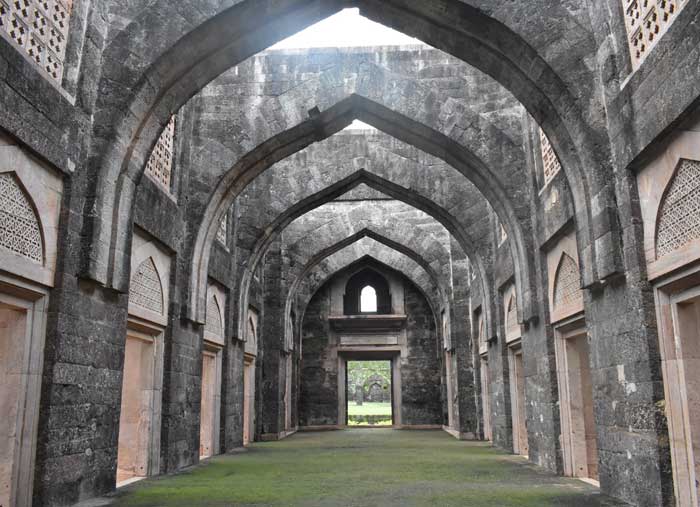
We walked around Jahaz Mahal, which resembles a ship about to sail. Hindola Mahal resembles the alphabet “T”. Baz Bahadur Palace, its finest water conservation system and the Afghan architecture were a sight to behold.
After a lot of walking, we headed to taste the local delicacies. Tasty “dal-baffla” and “paniye” were kept ready by Parvez’s friends. The lunch was planned at a sunset point but was changed due to a heavy shower of rain! In Mandu, we never know when the cloudy sky would pour on us and within half an hour the sky becomes clear with a rainbow. So be ready with a raincoat and a pair of closed shoes if you’re visiting Mandu.

In the afternoon we headed to Hoshang Shah tomb. In white marble, this is the inspiration for Taj Mahal. Later in the evening was at Roopmati Pavilion, where Rani Roopmati worshipped Narmada every morning. The Pavilion is accessed by a sloping incline and my mom, was the first one to reach the top. She was an inspiration to all of us.

On day three, in the morning we headed to Maheshwar. On the way, we stopped at Neelkanth temple. There are 70 steps to reach the temple and it is believed to be built by Shah Bagdah Khan for Emperor Akbar’s Hindu wife. There is a natural spring here, a peaceful place to worship.

At Maheshwar, we visited the Rajwada, which showcases Ahilya Bai Holkar’s life and story. And some weaving units. The fort is now converted to a hotel and has the finest Maratha architecture.
Then we went to some weaver’s shops and shopped for beautiful silk sarees, stoles, and clothing material. It was like shop till you drop there. Each material was beautiful and silky. Post a lot of retail therapy, we headed to our hotel, Narmada Retreat, which is on the bank of river Narmada. Such a pleasant stay! We settled in our rooms. In the evening, we headed for the peaceful “aarti” at the Narmada river.

On our last morning, we were up by 5.30 to watch the sunrise at Narmada ghat. I don’t have words to explain the beauty I had witnessed, the breeze, the majestic Ahilya fort behind, the song of the Narmada river, beautiful birds, and the crimson colour of sunrise. It was priceless.

We hired a boat and visited “sahastradhara” which means “thousands of waterfalls”. Its water streams pass through a rocky area, which creates a beautiful collage of waterfalls. Many birds flocked there. Do not miss “sahastradhara” even though it needs some walking. We bid adieu to Maheshwar very soon after, taking away with us, travel memories to cherish for life.

[featured-images]

No trip is complete without making a visit to the famous Meteora. The view from a hundred feet above sea level is surely breathtaking and no words are enough to describe this feeling. Somethings are best experienced with your own eyes, don’t you think so?

If you’re looking to experience the beauty of one of the country’s most enthralling destinations, Meteora, here’s our ultimate guide to visiting the abode.

Well, you can do it all by yourself, but a guided trip works wonders. After all, you don’t want to reach the destination and miss out on some important historical and cultural significance. An educated tour like ours will offer in-depth knowledge that goes beyond guidebooks.  With our trip to Greece, you will be able to walk through hidden trails that only locals know of

Best time to visit:-

Before you make your way to the mountains of Thessaly, make sure you know the best time to visit i.e late April to early November. But if you love to swim and sunbathe, late May to early October. Would be ideal. Those of you planning to go to Greece on a honeymoon, ensure to late visit between May to early October.

Background:

Meteora is one of the most visit places in Greece due to its unusual topography and important historical and religious site.  Situated 100 feet above sea level, the 6 active monasteries “suspended in the air” will surely take your breath away. They are located near the town of Kalambaka at the northwestern edge of the Plain of Thessaly near the Pineios river and the Pindus Mountains.

This sight alone itself attracts over hundreds of tourist every day. However, there was a time when there were over two dozen monasteries across Meteora.

How To Get There

By Train:

An affordable way to get around Meteora is with the help of a bus. Start your journey by simply taking a direct train from the Larissa Train Station to the town of Kalambaka from Athens. Just keep in mind that you book the round trip back to Athens from Kalambaka. This way the trip will work out to be affordable and ensure you don’t sit around wasting precious time that could be used to travel.

By Car:

Those of you looking for more freedom, hiring a car would be fun and let you travel at your own time. With a car, you can easily drive around the monasteries as it’s far more convenient.

Hike to Meteora with WeGoBond

Once you have reached the destination, tour guided hiking tour is the best way to learn the history of a UNESCO World Heritage Site. Our hike begins at the foothills of Doupiani rock, beneath the old ruins of Pantokrator monastery. From here, we cross through the immense rock formations to reach the northern side of Meteora. We spend some time discovering the hidden monastery of Ypapanti and the ruins of St. Dimitrios. As our tour guides are local, you are likely to hear stories and the legends behind each place you pass along the trail.

Once the hike is done, the bus will drop you off at the small village of Kastraki for lunch and then we return to our hotel.

Clothing:

When visiting the Meteora, it’s always a good idea to carry the right clothing. Carrying the right pair of shoes, a t-shirt and pants will make your hike comfortable and fun. 

Here are a few things that you just can’t miss out when hiking to Meteora 

2-3 pairs of shorts – Hiking is always going to be fun and bit tiring for those who are doing it after a long time. However, wearing the right clothes will not only help you pack light but also ensure your hike is comfortable. 

Ensure to carry 2-3 good pairs of track pants or shorts that will let you go hiking in comfort. 

3 tank tops or t-shirts – Don’t forget to match them with your shorts.

1 light jacket – let us tell you, it might get a little hot in Greece during summer, but do carry a light jacket as there is a sea breeze that is likely to make you feel cold.

2 bras – You don’t need many.

7 pairs of underwear – It’s always better to carry a few extra. You never know when you might need them.

2 pair of socks – the right pair of shoes and comfortable socks is all you need to keep your feet happy up to the hike.

Deodorant – a good deodorant will help you keep smelling nice as it is very hot

Sunscreen:

Considering it is going to be hot, wearing the right clothes might not be enough. Hence, carry sunscreen and apply it on areas that might need extra protection. (the back of your neck, face, etc.)

Hat/Cap:

Along with the right clothes and sunscreen, wearing a hat will not only keep you away from the sun but also protect your hair and scalp. 

Note:

Make sure you are physically fit and carry comfortable clothes and good shoes that will make hiking easy.

Dress code: The monasteries in Meteora have a strict dress code – women must wear a long skirt and a top with long sleeves. Overnight at Doupiani Hotel or similar.

Once you are done looking at the magnificent Meteora, there are plenty of other things you can do in Greece.

  1. Go on a private on-foot tour of Athens
  2. Enjoy sunset at Oia
  3. Stay in a beautiful boutique hotel in Santorini
  4. Visit the archaeological site at Delphi

Besides, our trips are planned in such a way that you get enough free time to go around and explore Greece all by yourself. So start packing your bags and get prepared to visit this magical destination and fall further in love with Greece.

[featured-images]

The flight from Mumbai to Guwahati was to take 3.5 hours. So, I had plenty of time to wonder about the Arunachal Pradesh trip on which I was about to embark. I hadn’t visited this part of the country till then. But I tried to curtail my excitement by reminding myself that the itinerary had warned of long journeys on bumpy roads for a major part of the trip. And luxuries were apparently going to be left behind as we proceeded from Assam to Arunachal Pradesh.

Now, about two weeks after my return, I smile amusedly at the image of that brooding woman staring out the aeroplane window. If I could, I would tell her that none of those apprehensions was worth a second of her time and that she was about to experience a wonderful vacation that would throw up many pleasant surprises.

The gist of the itinerary was this – we were to spend two nights in Kaziranga, Assam, and visit the Kaziranga National Park, which is a UNESCO world heritage site and is home to the world’s largest population of the Great Indian one horned Rhinoceros. From Kaziranga, we would set out for Arunachal Pradesh, covering three places in the western part of the state – Bomdila, Tawang and Dirang.

My heart lightens up now when I think of that divinely beautiful land.

Arunachal Pradesh can overwhelm you with its loveliness and enchant you with the spiritual tranquillity in its air. We would spend about eight hours travelling by Innovas every day, and the roads were often in bad condition. However, that was just a trivial side note in our travel story. From beginning to end, our attention was absorbed by the stunning vistas that surrounded us.

Splendorous mountains…lush fields…pretty villages…sparkling streams…verdant forests…clear blue skies with fluffy white clouds…gorgeous waterfalls…

Each morning, we would set out with a sense of adventure, and each evening, we would retire to our rooms with the contentment of having seen more breath-taking sights.

We visited serenely beautiful monasteries where monks of all ages were absorbed in studies and prayers. At the gorgeous Nuranang waterfalls, all the elements of nature seemed to come together to create a magical display. While strolling through a picturesque, tranquil Monpa village, I found it hard to remember what kind of lives we led in our bustling cities. The stunning Sela Pass had so much scenic beauty that it was difficult to decide which way I ought to stand and stare. At the Jaswantgarh and Tawang War Memorials, we heard incredibly touching and inspiring tales of bravery by the soldiers who fought in the Indo-China War of 1962 and laid down their lives for our motherland.

Patriotic emotions welled up again when we visited the Bumla Pass, which marks the Indo-China border, and saw brave soldiers who endure extremely harsh conditions to protect our country.

The roads that lead to Bumla Pass are in terrible shape. But the scenery more than made up for the gruelling drive. There are a few lakes on the way to the Pass, and we halted for a while at the exquisite Sangestar Tso lake. Then we continued on our journey to Bumla Pass, which lies at an altitude of over 16,000 feet. It was a surreal experience to know that we were standing in a place that separated one country from another. The visit to the Pass was undoubtedly a huge highlight of the trip and I will forever be grateful to Shibani for arranging the required permits for us.

Although the itinerary had said that luxuries would not be available post-Kaziranga, WeGoBondhad made the best possible arrangements for us and we got perfectly good and comfortable rooms at every place. Sejal, our group leader, was highly efficient, capable and caring. And her lively nature increased the fun quotient of the trip ☺. Our guide was knowledgeable, resourceful and friendly, as were all the drivers. As for the food arrangements during our daily road trips, the roadside dhabas served simple but delicious vegetarian thalis that were quite inexpensive.

It was an added pleasure to see neatly arranged rows of flower pots outside almost every house that we passed on the way. The flowers were of such riotous colours and shapes that I often couldn’t resist touching their soft petals just to confirm that they were real.

All in all, the trip to Arunachal Pradesh proved to be truly enjoyable and unforgettable.

The long drive up to Bumla Pass was especially memorable. The driver of our vehicle for that particular journey was a cheerful, humorous and talkative person, and he kept us entertained with interesting and charming titbits about the region and its people. It didn’t occur to me until later that he was probably trying to keep our minds away from the rocky roads. He also bought us chewing gum to help us deal with the change in altitude.

At one point, we disembarked to take pictures, and while getting back into the car, one of the doors wasn’t shut properly.

Our driver drolly said, “Madam, aapne door ko pyaar se bandh kiya hain. Lekin yeh pahaad ka gaadi hain….pyaar nahi samajhta.”

All of us chuckled, and after the door was closed forcefully, we set off again.

Those words of the cheerful Arunachali driver stayed in my mind for a while.

The vehicles that ply on those rough terrains may not understand love, but I believe the mountains most certainly do. Approach them with respect and reverence, and they will keep your safe. Approach them with a spark of love in your heart, and their cold purifying breeze will turn that spark into a glorious blaze. And as you stand in the midst of those silent, powerful and unchanging mountains, something inside you may be transformed forever.

Points to note while travelling to Arunachal

Carry the following:

  1. Medicines for nausea, headaches/backaches and altitude sickness
  2. Snacks/biscuits
  3. Sunscreen lotions
  4. Ample quantity of woollen clothes – jackets, sweaters, thermal wear, gloves, socks and a cap

Leave behind the following:

All your cares ☺

Courtesy: Ranjana Balagopalan

[featured-images]

How often do we travel to a country and hear stories about the remarkable beauty of the neighbouring country?

We felt the same on our maiden ladies-only holiday to Croatia – it was quite a success. But once there, Slovenia, the charming neighbour, lured us. This led us to plan a perfect route that takes you to both Croatia and Slovenia.

ladies only holidays india

So if Croatia and Slovenia, have been a favourite European destination that you want to visit for its beauty, historic sites and affordability, we give you more reasons why you should do it right now!

Here, we give you six reasons to pack your bag and get ready on our Ladies only Holidays to Croatia and Slovenia!

Zagreb

If you’re a fan of many fine sights, plenty of restaurants, cafes and bars, Zagreb will not disappoint you. And if you’re someone who enjoys art and history, the capital has the most number of museums that will keep you occupied for the day.
Also, if you want your wishes to be fulfilled, toss a coin into the Mandusevac fountain.
Don’t forget to take a picture and tag us #wegobond

ladies only holidays india

Rovinj

Looking to live in the greenest and liveable city?
Slovenia’s capital, Ljubljana lets you walk through the historical city centre and visit the 900-year-old castle. Besides, you can take a trip to the emerald-green Lake Bled, and feel the gushing waters of Vintgar Gorge.
Take a unique train ride inside Europe’s largest show cave in Postojna and walk up to the world’s largest cave castle at Predjama.

Yes, all this with our Croatia and Slovenia Trip! Need we say more?
Don’t forget to take a picture and tag us #wegobond

Good things come in small packages! That’s what we feel when it comes to the stunning small city, Rovinj. Bordered on three sides by the Adriatic Sea, on your visit here, you can seek out ancient ruins, visit unfrequented beaches and breathtaking natural spaces like the 10 kilometre-long Lim Fjord.

Plitvice

One of the world’s great natural wonder Plitvice Lakes in Croatia is a lush and pristine valley with 16 dazzling terraced lakes, 90 waterfalls and several kilometres of the boardwalk. With us, you will be spending the day hiking through the forests of this UNESCO World Heritage site.
So are you ready?

Split

Once done hiking, we then visit a town protected by UNESCO, Split.  Here, we stroll through the alleys of Split, stop for a drink at the many bars in the old town and soak in the past Roman glory.
But that’s not it!

Don’t forget to take a picture and tag us #wegobond

Dubrovnik

If you are looking to seek paradise on Earth, head to the enchanted city of Dubrovnik. The old stone buildings and limestone streets surrounded by well-preserved defensive walls of the old city are pretty impressive.

So if you have been a die-hard fan of Game of Thrones, book your trip now and don’t forget to enjoy the red wine, beautiful architecture and works of art on this ladies-only holiday.

Have a look at more ladies-only holidays by clicking here.

[featured-images]

When I mentioned to my friends and family that I was going to Korea, there were a series of questions – Why? What’s there to see in Korea? Are you sure it’s safe? And of course, the over smart one – north or south? I couldn’t understand the reason for these questions – no one asked me these when I visited Italy or Croatia earlier this year. Yet, it was my visit to South Korea that had my well-wishers mouthing concerns. And that just made me more adamant to go!

So why did I actually want to go to South Korea? Apart from the honest truth that the dates fitted perfectly, it was also because it was a country I’d never considered visiting. Sadly whenever I did hear about South Korea, it was in context to their troubled northern neighbour. A neighbour which has intrigued me for long, a country I’m absolutely forbidden to visit by my family, and one I won’t on ethical grounds as tourism there benefits only the government and not the people. So when the opportunity came to visit South Korea, I grabbed it because I couldn’t go north. And I’m so glad I did.

After a disastrous flight on China Eastern, and a missed connection, a co-traveller and I arrived in Seoul in the evening. As we drove into the city we were greeted by clean, well maintained roads, no horns and dazzling lights. It was over the next few days when our guide, a brusque, grandfatherish, knowledgeable man called Kim, reiterated how poor South Korea was till the 1950s and how the country had overcome that situation, did I actually understand how proud the citizens were of their country.

We were a small group of women – nine of us – from different parts of India. And that’s the beauty of trips like these, the joys of meeting new people and learning from each other. With Kim to guide us around our days in Seoul were spent sightseeing (we saw North Korea from a very safe distance) to walking down the streets of Meyongdong eating street food and buying cosmetics.

It was Gyeongju though that became my favourite. We spent the evening exploring the Bulguksa Monastery followed by a tea ceremony with a young monk. The gentleness of his ways, the calmness that he exuded left me wondering if I would ever be able to feel like that in my urban life. Or is that kind of inner stillness possible only if we move away from external disturbances? While I didn’t ask him any of these questions, we did ask several including ones on love and relationship, which turned his cheeks red. Even the simple vegetarian dinner at the monastery was scrumptious and if I say we overate, that would be an understatement. Later, we joined the priests in offering evening prayers and while it was a unique experience it turned into the much needed workout session after binge eating. We were asked to follow the priest and to my horror he kept doing prostrations.

Busan was a delightful experience, with the contrasting quirky Gamcheon Cultural Village to the modern Haeundae Beach area with flashy lights and busy restaurants. It was here that I enjoyed a traditional Korean bar-b-que, a pleasure for any meat lover. On the grill atop the table meat of your choice is cooked in front of your eyes. Along with the meat there are a hundred tiny bowls with variety of kimchi and salad leaves to add flavor. We devoured every bit of food on our table, and then, feeling guilty, walked along the shore to digest our humungous meal.

Our last stop was Jeju Island, a destination that often crops up in the visa free places list for Indians. Filled with tangerine gardens and plantations this vast island almost seems uninhabited in certain parts. From the airport we headed to Love Land, which had more comical than erotic statues of couples engaged in sexual acts. We also visited Jeju Folk Village, the home to the female divers, whose average age according to our guide was sixty-five. In fact the village boasted of a granny who was 109 years old, and two others who were above 100. The village supports its economy through products made and sold only there, and I dared to buy a facial cream made of horse lard and tangerine. Someday I’ll dare to use it.

As the colours of autumn swept across South Korea they painted the country vibrant reds, maroons, browns, yellows and greens. And these colours, interspersed with glittering lights, remain etched in my memory. My week in South Korea was certainly well spent.

-By Richa Wahi

[featured-images]

Question: What happens when you are stuck in a rut, exhausted with the mundane, and feel like your life has come to a complete standstill?

Answer: You go jump off a mountain!

And jump off a mountain I did with WeGoBond’s three-night getaway to Andretta.

Nestled among the Dhauladhar range is an idyllic artists’ colony and the village of Andretta. Established in the 1920s by Norah Richards, the Irish theatre artiste and environmentalist, Andretta has, over the years, attracted many noted artists, painters, and more recently potters. Steeped in culture and a bedrock of Punjabi theatre, this quaint little village in the Kangra valley exudes a charm that is second to none. I was about to get a deep dive into all this and more during my three-night stay in this beautiful village.

It’s 5 p.m., my flight has landed at the Delhi airport, and I make a beeline to the taxi stand and instruct the driver to take me to the bridge near Majnu ka Tila, where all the buses for Dharamshala convened. With some Arijit Singh and A.R. Rahman for the company, I reach my destination without much fanfare. The bright green Bedi Bus against a full moon on a yet-to-be-inaugurated bridge made for a striking setting. I meet the rest of the group. While we wait for the other passengers to board, we put this time to good use and get to know each other—the four other lovely ladies with whom I’d be spending the next few days.

At dot 8 p.m. the driver signals that we are about to move. Once on the bus, I doze off to the din of Judwaa 2 playing on the screen in the foreground. Although I’ve travelled on a sleeper bus in the past, this one was a unique experience. I thought I was in for a bumpy ride, but lo and behold I slept like a baby during the entire eight-hour journey. The full moon played hide and seek as the bus trudged around the winding hills once it left the city limits.

My beauty sleep was interrupted by the conductor’s announcement at the crack of dawn the following day. ‘Chalo Bhai, Dharamshala Walley utro!’ We had reached our destination.

Dharamshala is situated in the Kangra valley, at an elevation of 4,780 feet, in the shadow of the majestic Dhauladhar mountains. It is the second capital of Himachal Pradesh (the first being Shimla), and the residence of His Holiness the 14th Dalai Lama and the centre of the Tibetan exile world in India.

It was late October and the early flurry of snow on the majestic Dhauladhar signalled the onset of winter. As a desert dweller, the white carpet of snow was a sight to behold! The crisp air and the early morning sun instantly began to work its magic on us. A quick breakfast of aloo parathas and masala chai from a roadside restaurant and we were on our way to the Mirage, our wonderful homestay in Andretta.

The Mirage was one of the key highlights of our Andretta trip. The property is owned and run by Denis Harrap and his fantastic team—including Sweety, the friendly German Shepherd who kept us company throughout our stay, accompanying us even on our hikes and market walks—who made sure we had a lovely time and gave us a taste of the pahadi lifestyle. Built in 1948, the property is the perfect hideaway to soak in tranquillity and rejuvenate those frayed city nerves. It has a stunning yoga room and a swimming pool (under construction). The rooms are well appointed, with unique artefacts curated from across the world, giving us a glimpse of Denis’s extraordinary travels across the world. We stayed in the White House, a two-storied Himachali mud house with a cosy fireplace. Reproductions of Amrita Sher-Gil’s paintings made for a striking look against the whitewashed walls, and so did the vintage calendars and posters from the bygone era.

The Mirage is a labour of love, and this is evident in the attention that has gone into creating this beautiful haven—right from the name-sign on the cottage gate to the dinner plates and bedside tables, all managed efficiently by Denis’s hardworking team. My favourite bit about my room—amongst many others—was the bed-heating blanket, chanced upon accidentally. While it wasn’t too cold to use it, I found it was an excellent remedy for aching knees and sore muscles.

After taking in the surroundings over a cup of masala chai and locally made butter biscuits, followed by a delicious Himachali lunch of dal, chawal, and sabzi, we head straight for our 2 p.m. appointment with Shubham at the Andretta Pottery and Craft Society. The next two hours go by in a swirl at the potter’s wheel, throwing and moulding, and getting the clay to yield to our command. The entire experience was therapeutic, from turning the wheel, to the cool clay awaiting its destiny at the potter’s hand, I walked out of the centre in a state of zen.

Next came the village walk with stops at Sobha Singh Art Gallery and Norah Richards’s house where she taught students how to perform plays in a small theatre outside her courtyard. Her house has recently been renovated by the Punjabi University, Patiala, with the skills of local artisans. The courtyard theatre is still in use by the Punjabi university students, where plays are performed every year on 29 October to commemorate Norah’s birthday. As I explored the 1935 mud house, I felt a strange sense of déjà vu—this was a world so far removed from mine, yet it felt like I belonged here.

Under the now-waxing moon the five of us, with Sweety in tow, spent the rest of the evening exploring the nooks and cranny of this beautiful little village and mingling with its warm and hospitable locals. We kept things simple and easy today because tomorrow we were all set to face our mountains and needed to be in the best form possible.

At 4 a.m., our trip lead, knocks at our door. ‘Wake up, it’s time to rise and shine!’ Little did she know my roomie and I were all set—suited and booted—ready to take off. After a hot cup of masala chai, we carefully tread the winding steps and make way to our car waiting to take us to Bir-Billing, one of the best paragliding sites in the world. The half an hour drive to the take-off site at the crack of dawn is scenic, and witnessing the first rays of the rising sun on the Dhauladhar range is mesmerizing.

Amit and Meenu, the husband-and-wife duo, meet us at the landing site at Bir. Once a corporate slave, Amit and Meenu decided to leave their city lives behind and moved to the mountains. Certified paragliding pilots with more than 700 hours of flying experience between the two of them, they now run BeOutdoors, an adventure eco-tour agency.

A short drive uphill to the take-off site at Billing, followed by some final instructions from Amit helps keep my mind occupied from the unthinkable. ‘Look straight ahead, don’t look down, just straight ahead and run, run, run … keep running, don’t stop,’ Amit instructs. Standing at an elevation of 7,900 feet, I have an epiphany: I wonder if Amit’s words are the antidote to my stuck-in-a-rut life situation.

My heart starts to race, Good lordy, what was I thinking, what did I sign up for? Perhaps a spa day would have been a better solution to drive away the blues!

Eddie, my tandem pilot, is cool as a cucumber and his calm demeanour doesn’t help soothe my frayed nerves. Eddie has been setting up the glide this whole time. He then ties me up, straps me up. I’m hooked and booked from all angles possible. There’s no way out. Eddie signals it is time to run. I take in a deep breath and with all the courage that I can muster I run. Six steps in, and suddenly there is no ground beneath my feet. I’m up in the thin air, sitting nicely on the glider’s seat, as Eddie navigates the bright orange glide. That was it. I spend the next twenty minutes taking in the views—the rising sun, the majestic ranges as far as the eyes can see, down below little villages with freshly tilled farms, red-tiled roofs where perhaps the inhabitants were just about waking up to the new day. Bliss!

The warm rays of the sun and the cool pahadi air made for a heady combination of ecstasy, hysteria, and a deep sense of gratitude. Tears streaming down my face, I had another moment of great realization. You see, I have a natural affinity to complicate things—whether it was jumping off a mountain or going about my daily life. Sitting on the glider, balancing a Go-Pro in one hand, and holding on to a plastic strap for my dear life I made a note to myself, to keep it simple, always!

We land at Bir, which I can only describe as a warm knife slicing through a block of butter. Utterly smooth.

Exhilarated, we make our way to Apoorva’s coffee shop, a few metres away from the landing site, for some delicious coffee and carrot cake. With our tummies full, we proceed to visit the number of monasteries along the way and stop for lunch at one of the monastery canteens for some thukpa and thenthuk.

Mind, body, and soul aligned, we head back to our homestay, and, as if it was a done thing, I turn on my bed heater to the max and go in for a four-hour snooze fest! After a relaxed dinner, we call it a day.

It’s day three now, our last and final day before we take the overnight bus back to Delhi. Excited to see what the day holds, my roomie and I are up bright and early as always—suited, booted, packed. There’s a village hike on the itinerary, followed by a scrumptious breakfast, then on to the HPCA cricket stadium in Dharamshala, and finally to Mcleodganj, with a visit to a church and the Bhagsunag waterfalls.

I’ve done many hikes, this should be a walk in the park, I tell myself. And it sure turns out to be one—except for the last leg of the walk when my sedentary knees decide to make a point. Ssshh, bad timing. Be quiet. I say and trudge along. Although slightly difficult in bits and places, the views of the surrounding ranges and the idyllic villages at its foothills are stunning.

Hike done and feeling mighty accomplished, we head back to a beautiful breakfast spread of besan chila, scrambled eggs, a gorgeous fruit platter, and an assortment of homemade jams and pickles. Breakfast devoured, we say our goodbyes to our wonderful host and hit the road to Mcleodganj. The rest of the day is spent sampling more thukpas and shaptas, exploring Mcleod’s meandering alleys, coffee shops, and dipping our tippy toes at the Bhagsunag waterfalls.

It’s now getting dark; the last ray of the setting sun demonstrates her final act across Mcleod’s skies—a kaleidoscopic display of brilliance in all shades of red. What a showstopper! This has been a magical day! We take in the panoramic view and get into the waiting bus.

As the bus begins its descent from Mcleod, I assume a comfortable position and doze off, this time to the backdrop of Happy Bhag Jayegi!

It’s 4 a.m. now. We’ve reached Delhi, I can tell by the heavy smog-filled air. Now comes the toughest part. The goodbyes. The bond we shared over endless cups of chais, crispy onion pakodas, buttery biscuits, and countless selfies, the five of us will shortly go in five different directions. I don’t know what it is, but I feel a gnawing pain deep within. I remind myself we live in the digital age and just a DM away. I instantly feel better. My attempt at ‘keeping things simple’ is working!

Tight hugs and promises to stay in touch, we go our separate ways. I turn back for one last look. Three days ago on a full-moon night we met; three days later batteries fully recharged, with new-found hopes and inspiration, we march ahead carrying the spirit of adventure in our hearts and the search for our next big mountain.

Until then, here’s to sisterhood and our travelling plans!

Priscilla Stanley travelled to Andretta with WeGoBondin October 2018. She does not travel often by your average standards, but when she does you can rest assured that she is doing so to break free from life’s mundaneness that has set in at a tiresome pace. This was Priscilla’s fourth trip with WeGoBond. Previously she has travelled with them to Sri Lanka, Chikmagalur, and Puducherry, all of which she says has been life-changing and transformational.


Photographs courtesy of Madhula Banerji

[featured-images]

Menchuka means medicinal water of snow. I am tempted to interpret it as divine land in the lap of snow. Pristine and untouched, vouched for by the lack of good roads leading to it.In fact, every stone that juts out on the path, making it an extremely bumpy drive leading to this slice of heaven, is proof that man’s greedy eyes have only just begun to settle on it.Hills, mountains, rivers, valleys, and…hold your breath, quaint and exotic wooden and bamboo bridges – you name it and you have it by the dozen. Variety of flora that you could lose count of, each more exotic than the other.

Well, what or where is this Menchuka?
It is a small valley town nestled 6000 feet above sea level in the West Siang district of Arunachal Pradesh, the land touched by the first rays of the sun! For fact collectors, it is considered the last village before the McMahon Line dividing India and China. Beyond Yorlong, civilians are not allowed and the area is patrolled by the 13 Kumaon Regiment. While visiting the town, it is worthwhile visiting this place and saluting the soldiers, who have traded the comfort and security of family life, for this perilous vigil so that you and I sleep in peace…

One gets to this place, first by reaching Dibrugarh in Assam, then ferrying across the mighty Brahmaputra river from Bhogibeel Ghat, and thence to Pasighat, Arunachal Pradesh by road. The ferry experience is no ordinary one. Along with us, our SUV vehicles are also loaded on the ferry and carried across the river. Hats off to our young and incredibly brave and talented drivers!

Pasighat is the headquarters of East Siang district. Its around 150m above sea level and from here starts the ascent to Aalo or Along. The roads are bone rattlingly bumpy but the scenic beauty takes your breath away. You almost forget the physical discomfort when you feast your eyes on the ethereal surroundings.

Wild banana trees, growing in such profusion with the purple flowers that we normally see, along with orange and pink flowers which we never knew existed. Of course, there are all varieties of bamboos and pines too. And sooo many other plants and wild flowers that you could spend a lifetime studying them. Arunachal is home to the exquisite orchids and to see them casually blooming in the wild, one feels as if they are teasing you! And throughout the course, we follow the Siang River. Siang is formed by the confluence of Yomgo(China) and Siyom(Tibet). Siyom flows through Menchuka and as we drive towards Aalo from Menchuka, we see the sangam of the green Siyom and the blue Yomgo to form the Siang. Just for information, Siang is joined by Lohit and Dibang to form the Brahmaputra! So Brahmaputra enters India from Arunachal Pradesh. The route is not exactly teeming with eating joints but the few and far between ones are located at very scenic spots. We stopped at one near an incredibly tall waterfall and had the tastiest Maggi for lunch. You get dal roti too.

The most preferred form of accommodation is Homestays in Aalo and probably the only form currently available in Menchuka.
A visit to the tribal villages in Aalo was an eye opening experience. The architecture of villages in mountains is very different from those in plains.
Levelling is of prime importance here. Hence all houses are built on stilts. Bamboo and palm leaves are the main ingredients. The huts, are basic, need based, neat, practical, and look deceptively fragile. But, these are very sturdy and have stood the test of time. No frills, no cluttering. It leads one to wonder, who taught these simple people physics, maths, and engineering that they built such scientifically sound structures? Its ironical that long long back, when there was no organized form of education as we know it today, man probably knew more about nature, .. and himself. These simple people teach you the most profound lesson that, all that there is to be known, lies within us.

Another bumpy drive takes you down to a valley and you rub your eyes and pinch yourself to believe it’s real. It is…..Menchuka…
The homestay here is Gebo’s Lodge. I think that’s the best part of the trip. This living with the inmates, sitting in their kitchen, watching them go about their daily chores, while the lady of the house cooks meals, giving us an update about the latest gossip, chiding her husband, admonishing her kids….What better way to get the real feel of this place and see the lifestyle of the people?

I can still taste the thukpa(their khichri),momos(the lady taught us and we prepared them!) and butter chai(with salt)served around a fireplace with such simplicity that it at once warms the mouth and the heart.
Actually, the area south of the McMahon Line, now officially part of India, was inhabited by Tibetans. Hence, the cuisine. Rice beer brewed from rice and millet is the favourite alcoholic drink here. Customs and traditions have been developed that enable the people to adjust to nature and revere it, rather than manipulate and destroy it.
Even birds chirp and tweet contentedly and nod their deep satisfaction to belong where man and mountain are at peace with each other.

The local religion is DonyiPolo (Sun-Moon), which is heavily influenced by Hinduism, in worshipping nature and the philosophy of maintaining balance of nature. It is believed to be the land where Sage Parashurama washed away his sins and where Lord Krishna married Rukmini. Massive conversions in the mid and late 20th century by Catholic Christians has led to Christianity being a major religion here. Buddhism is also followed and Menchuka has some of the oldest monasteries of Arunachal Pradesh.

There are a few Buddhist monasteries on mountain tops, so that calls for a great trekking experience, not for the level of difficulty but for the sheer views.

One can have one’s fill of walking on wooden and bamboo bridges for there are plenty of rivers in Menchuka. A meditative experience, for one has to be totally focussed on the next step while walking on these deceptively simple contraptions. And when you are right at the center of the bridge, the way it swings, can be nerve racking!
Ultimately, the elegant magnolias, the majestic rhododendrons, and the elusive orchids of Menchuka teach you that no matter where you mark the compass of your journey, the real destination lies within.

[featured-images]

It is exactly two weeks today since I got back from Spiti but I already want to go back! Is it soon, I ask myself? And then I realize, deep down, I never wanted to return. But since that was not possible, I left a large part of me there. That way, in search of that, I will always find ways of going back.

I have had the luxury of being a world traveller since the last 35 years. No place would touch me the way Ladakh did in India, and Kenya, from amongst the ones abroad. Or so I thought. Till I felt Spiti.

Spiti is remote. Spiti is harsh. Spiti is stark. Spiti is beautiful. Spiti is magic. It tears your heart out, it wrenches your gut, it makes you cry but always leaves you wanting for more!

Its beauty has a vibe which makes one almost cry at times; there is an aura and a peace to the prevailing quietitude. I have never felt closer to the powers that look upon us and to myself as I did in Spiti.

You may think, on reading the above, that I spent all the time by myself. On the contrary; but Spiti called out for some moments only with self and I am happy I succumbed to that charm.

Spiti and the tour was all I had ever imagined it to be! It must be after years quite literally that I was on holiday w/o any family member and in a Women only travel groups where I knew no one. The anonymity that comes on such a journey is liberating. I would have liked to do it in 2015 when I turned 50 but I’m glad this worked out when it did because I was meant to do this with WeGoBond and with this wonderful group of people.

Group travel is addictive in its own way and a terrain like Spiti becomes more doable in a group. WeGoBond had an itinerary which left space for flexibility, for a change in plan or extra time. I will not forget how a request by 2 of us from the group to include Chitkul, the last village on the Indo-China border beyond Sangla, Kinnaur was acceded to. It is not often you find tour organisers willing to even listen to on-the-spot requests leave alone trying to make them happen. Or an unscheduled stop because a certain dhaba looked inviting and the fragrance of samosas was too enticing! Not to forget the innumerable photo stops. All of this done with a smile, but without allowing the day’s itinerary and time schedule to get disturbed.

WeGoBond’s research and eye for detail was obvious throughout our 10 day trip. Their professionalism showed in their choice of vehicles, the drivers who navigated the difficult roads (sometimes non-existent) with confidence and patience, in their endeavor to make long, backbreaking road journeys more pleasant by including a specially put together song medley on personalized pen drives and in their choice of accommodation.

Our trip began from Chandigarh on Day 1 where the group converged from different parts of India. It was about an 8 hour drive to Narkanda our first halt for the night with lunch and a tea stop thrown in. Narkanda was cloudy and misty and we glimpsed a beautiful sunset before we headed to our rooms to freshen up and then to bond over a bonfire. We were all meeting as strangers and who knew then that 10 days down the line we would part as thick friends?

Day 2 was one of our longest days in terms of driving hours on really bad stretches of treacherous roads. However, it was also the beginning of fulfilling sights, moving along the River Sutlej, crossing curves and winding roads which brought forth the adrenalin rush. The drive ended in Sangla where we were hosted in tents in the middle of a beautiful apple orchard. We also celebrated the birthday of one of the travellers in the group with much gusto and song.

Day 3: Happiest we were when the tour coordinator announced the possibility of adding a detour to Chitkul, the last village on the Indo-China border. The drive from Sangla to Chitkul was a heavenly one and Chitkul has a beauty which left us mesmerized.. An hour in Chitkul and then we backtracked our way to Karcham from where again we drove along the Sutlej till we reached the confluence of the Sutlej and the Spiti rivers. Changing course to move along Spiti we left the dense wooded forest and verdant greens to move into Spitian landscape of barren mud mountains. Our halt tonight was at Nako in another campsite quite at a height.

Day 4: An early morning village walk to Nako Lake and the monastery and we were off to Tabo, an almost entirely Buddhist village boasting of a monastery built in 900 AD. The monastery has some exquisite paintings and frescoes and is often called the Ajanta of Spiti. Some meditation caves in the hills added to the mystique.

Day 5: Tabo to Kaza was a surreal drive through the Pin Valley. We were lucky that it had opened up. Till a few days prior to our arrival Pin Valley access road had been obstructed by a sudden landslide which had made the region inaccessible for over a month. Pin Valley brought the best of barren mountains and the river interspersed with green fields. A quick visit to the Gwe monastery to see the mummy remains of a Buddhist monk and then we were off to Kibber via Kaza.

Day 6: The evening before at Kibber was one which will remain as my most favorite memory of the trip. High, literally on a high, at 14000+feet we could reach out and touch the clouds or pluck the stars. It was moment of connect with divinity. Kibber itself is a small village laid out in a bowl surrounded by fields and snowcapped peaks. The homestay which hosted us was very inviting as were our hosts. The night was spent on their mud roof in silence with friends and nature. This was also what had been our most dreaded moment ” the dry toilet which was only a hole in the ground”. Suffice to say that hygiene and sanitation conditions in Kibber far surpassed those of the cities!

Day 7: At Kaza, a free day and how lovely it was. To be able to stop and stare, to be able to stand and breathe, to not get into a car. This break was very welcome and again it was very thoughtful on the part of WeGoBond to have factored this in. Hotel Deyzor, our home in Kaza, was paradise and deserves a post by itself.

Day 8: It was time to bid goodbye to Kaza and Spiti and make our way towards Kunzum Pass and Chandratal Lake. Today’s and the following days drives were to be breathtakingly spectacular but back breaking. Long drives of 10 hours at high altitudes. It was only the music, the extraordinary views and our own laughter which saw us through. The night was spent camping at a site about 2kms away from Chandratal Lake. The lake did not offer us its best views as it was cloudy and had begun to rain because of which we got only about half an hour in all. A little bit of an anti-climax for one of the high points of the trip.

Day 9: Chandratal to Manali was on a road which was non-existent, full of overflowing nallahs, rocks and stones and jerks. It is a wonder we arrived in Manali a good 10-11 hours later in one piece. However, Baikunth Resorts and a good hot shower energized us once more as we took off for a farewell dinner, tinged with bittersweet sadness.

Day 10: Yes, it was time to go home laden with precious memories, and new friendships. A long drive through Kullu Valley along the Beas brought us to Chandigarh and we boarded the Shatabdi yet again . It was not an adieu bit only an au revoir, till we meet again.

Photographs credit by – Jayanti Pandey